What's the best skill to learn to be AI-ready in 2026?
The Answer May Surprise You! (And the same is true of the skills we should be hiring for).
AI & Literacy | AI & the Humanities | Career Prospects | AI & Corporate Innovation | AI & the Social Sciences
Average reading time:
Target audience: Beginners / Novice
The Most Important Skill to Learn for AI Engagement
Now that the era of AI is fully underway, it would be reasonable to expect that digital skillsets of some sort (as opposed to analogue ones), would be the most valuable to learn in 2026.
The Importance of Clear Communication in the AI Age
We would argue however that this is (rather counter-intuitively) not the case and that generative AI has shortened the gap between idea and outcome to such an extent that the most powerful and effective skill right now is the ability to formulate ideas into artfully crafted sentences that can be leveraged as "killer prompts".1
In fact, (thanks to the advent of AI) the ability to write well is now as important a digital / technical skill as the ability to code, if not more so. Moreover, in the past there used to be a significant chasm between the humanities and technology, but now they are interfaced with each other almost seamlessly.
If you're going to learn one thing in 2026, now more than ever, the most important skill to work on is attaining a level of literacy that will embellish both your written and verbal communication skills.
And, if you want to become an "AI genius", then the competencies you need are actually fairly analogue (and human-centric).
AI and Literacy, Literacy, Literacy!
Literacy & how to use AI effectively
As the year in which AI finally embeds itself deeply into everyone's work life, personal life, calendars, creative projects, technical projects etc, the only thing that's going to make you stand out from the crowd is a strong command of the English language (and effective communication) when it comes to AI-fluency.
Literacy & AI prompt writing
Whatever you're working on, you need this in order to make your generative AI prompts better so that you get outcomes and outputs that stay ahead of the competition.2
In many ways, this isn't just the age of AI, it's also the age of the wordsmith and the more creative energy you put in (combined with an aptitude for diction, snytax and an awareness of domain, tone and register) the more you'll get out.
Words are now productivity tools more than they have ever been in human history and it stands to reason that the better you are able to use them the better placed you are to achieve your aspirations and ambitions.
Moreover, the more you cultivate your literacy skills, creative imagination and so forth the better you will be able to fortify yourself with the adaptability and resilience needed to thrive in a modern, fast-moving world of constant technological and societal shifts.
AI, the Humanities and Vocational Learning
The Role of Humanities in an AI-Dominated World
If you want to succeed in the Age of AI, then its probably best to think of AI less as computer software or as a super computer and more as a voracious reader, a sponge for information and a synthesiser of knowledge. Those attributes sound very much like what the humanities teach us right?
So it follows that, if you want to work effectively alongside AI then those are the very skills that you need to foster and nurture in yourself.
When you think about it, 2026 should also be "The Year of the Humanities" and one in which primary, secondary and tertiary education systems need to give serious thought to restoring humanity subjects to the forefront of their curriculums.
When it comes to funding, careers advice, Department of Education policy and so much else this should be prioritised in everyone's minds.
Now is also the time to do away with the prevailing idea that the humanities are something different to (and separate from) vocational learning. In fact, in an amazingly brief period of time, they have become the essence of vocational learning. All thanks to AI!
Finally, we have a good news story for the humanities after decades of erosion and of being gradually relegated into the second division of our educational systems!
AI, Literacy and Career Prospects
Literacy is the most important professional skill to cultivate in 2026.
Literacy is the place to start if you:
- Want to improve your workplace performance with AI.
- Are afraid that AI might take your job.
- Or even if you want to create a job, career or business for yourself that relies on AI.
- Literacy should also be the place to start if you want to embark on any creative project or artistic venture that involves AI, personally or professionally.
Whenever there's a technological revolution there are always winners and losers, but in the past the barriers which prevented the losers from becoming winners were much more insurmountable (I'm thinking of Luddite protests in response to technological advancements in the weaving industry in the 18th Century and of the Wapping strike in 1986 and the advent of digital typesetting as two examples).
With AI the situation is quite different, and infinitely more meritocratic.3:
- Firstly, because we all have the opportunity to embrace it.
- Secondly, because the linguistic skills needed to become an AI power user are not totally beyond anyone's grasp.
Perhaps the only true barrier between anyone and them being on the bleeding edge of technology is now their command of the English language.
Preparing for AI-Focused Job Roles
So get reading, take a creative writing class, take an interest in English Language and Literature, join that book club or debating society, learn improv or public speaking, register for that A-Level, apply for that Bachelors Degree. Approach it however you choose, but make no mistake these skills are more essential than ever for future-proofing your career prospects.
AI and Corporate Innovation
Creative thinking is the most important professional skill to hire for in 2026
And if you're hiring, then you want to be looking for those humanities graduates, autodidacts and free thinkers who are best placed to deliver both excellent creative and technical outcomes through their engagement with AI.
Creative Thinking as a Career Differentiator
It's also worth pointing out here that within organisations AI is often deployed mainly within the operational framework of the business and in quite a task-oriented way (see, for instance, our Integrating Copilot with SharePoint and Teams course).
This means that many of your AI assistants and AI-driven processes are confined by the limits of the content and information repositories that exist within the organisation. These are what your instances of AI learn from and they define the parameters of its knowledge-base. Of course, this does offer great efficiency savings and opportunities in itself when it comes to streamlining workflows, tasks and processes.
However, it also means that it is as crucial as ever to recruit those who bring innovation to the table, because your implementation of AI might even be the box that people need to think outside of in order to innovate and scale.
AI and the Social Sciences
The great irony here (if no one has spotted it just yet), is that artificial intelligence has made all the things that make us human (culture, literature, history, sociology, psychology, anthropology etc. ad infinitum) the very knowledge tools that we need to get the most benefit from AI.
Douglas Adams makes the point beautifully in his Hitchhiker's Guide to the Galaxy4 trilogy. The problem with the Mice's quest to discover "What is the answer to the meaning of Life, the Universe and Everything?" wasn't with the answer that the artificially intelligent super-computer Deep Thought gives to the question. The problem was with the question itself. AI is only as useful as the "prompts" (questions / instructions) that we give it/them.
Literacy, creative thinking and knowledge of the social sciences are what will enable us to get the best out of AI every time!
Or, to put it less prosaically:
The limits of AI are defined only by the bounds of our capacity to express our imagination. And, our imaginations are the meta data of this new frontier.
As a final thought, we should also now be considering how social science skillsets are going to start bleeding into the actual sciences with the help of AI over time.
Could, for instance, an interpretive dancer now be as qualified as a professional biologist, to use AI to reveal new insights into how bees communicate? It's an off-the-wall thought, but that's perhaps part of the point.
Notes
1) It's unsurprising, of course, that there are also generative AI services dedicated to making your prompts better. The process of using AI to enhance prompts is known as "Meta Prompting", as opposed to the "Chain of Thought Prompting" (CoT) we've been discussing. For a deep dive introduction to Meta Prompting you can explore
In fact, daisy-chaining your engagement with AI is one of the most productive strategies you can leverage. So you might write your prompt > use AI to improve your prompt > execute your prompt > use the ubiquitous "Make this better" prompt to enhance the output > use the output as a script for an AI generated video > and so on and so on.
The possibilities are endless.
See, for instance, https://originality.ai/blog/ai-prompt-generator.
Some AI services even come with prompt enhancers built in, but they may of course take you into tangents that diverge from your intention. For most less-complex tasks, there is no substitute for being linguistically equipped to sculpt your prompts for the best and most relevent outcomes yourself (or so we argue).
2) What's true of individual prompts is even more true when it comes to extended, complex conversations with AI assistants, taking in complex workflows and even whole projects. Remember that these chatbots are far from perfect (and they're not psychic) so you are going to need to communicate effectively to get things done right and efficiently.
And here's a Top Tip for Working with AI for you, since you made it to the footnotes (well done!):
When you're working on a task with an AI chatbot you're also training it. So, what seems insurmountable on day one, might be a breeze on day two. So persevere and the better you communicate, the faster your AI helper will give you the results you're looking for.
Until you've nailed the workflow for each of these engagements, expect to be asking your AI assistant questions such as 'Do you understand?' and 'Do you remember?' quite a lot.
3) Albeit, I should acknowledge here that the "Rise of AI" has been the source of much concern from within established creative industries due to the threat it poses to intellectual property and back catalogues of creative output from which an artist's idiom, style, voice and much else can be appropriated without permission, acknowledgement or attribution. This however is a separate subject.
4)
By
Acknowledgements
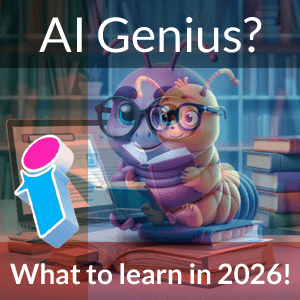
With thanks to Leonardo AI and Microsoft Designer for the two bookworm caterpillar images to which we then applied layers, opacity, a few opaque shapes, text (and little more) to morph together into the graphic for this page.
Thanks also to Microsoft Copilot for suggesting a couple of last-minute editorial flourishes that I wouldn't otherwise have been able to include.
If you found this article useful you might also enjoy:
Copilot Licensing Guide for SharePoint and Teams.
And, 10 Copilot Prompting Tips For Beginners.
See also our Copilot Integration with Microsoft Excel for Power Users course.
We really ❤ helping organisations to master Microsoft and Adobe software. Our only question is: Will it be yours?
 0844 493 3699
 email us